
I. Natural Material Diffuser Flowers
1. Plant Fiber-Based
| Type | Porosity (μm²) | EO Loading Capacity | Peak Release Time | Representative Brands |
| Cotton Non-Woven | 15-30 | 0.8-1.2g/g | 24-48hr | ZARA Home |
| Wood Pulp Composite | 50-80 | 1.5-2.0g/g | 72-120hr | Muji Minimalist Series |
| Coir Fiber | 100-150 | 0.5-0.7g/g | 48-72hr | Southeast Asian Style Diffusers |
2. Mineral-Based
| Diatomite Flowers | Nano-Pores | 0.3-0.5g/g | 240-360hr | Muji Dehumidifying Diffusers |
| Gypsum Flowers | Micro-Pores | 0.2-0.3g/g | 120-168hr | Car Vent Diffusers |
| Volcanic Stone | Honeycomb Structure | 0.4-0.6g/g | 300hr+ | NEOM Luxury Wellness |
II. Synthetic Material Diffuser Flowers
1. Polymer-Based
| Material | Structural Features | EO Compatibility | Lifespan |
| PE (Polyethylene) | Closed-Cell | Water-Soluble Only | 1-2 Weeks |
| PU Foam | Open-Cell Rate ≥95% | All Oil-Based EOs | 4-6 Weeks |
| EVA Foam | Cross-Linked Networks | High-Viscosity Oils | 8-10 Weeks |
2. Functional Composites
- Activated Carbon Flowers: Specific surface area ≥1500m²/g (Dual formaldehyde removal + diffusion)
- Photocatalytic TiO₂ Coated: Decomposes VOCs under UV (Ideal for new vehicles)
- Thermochromic Polymer Flowers: 32°C lattice change accelerates diffusion
III. Industrial-Grade Diffusion Carriers
1. Ceramic Core Flowers
- Precision Parameters:
- Pore size 0.1-0.3mm (Capillary control)
- Alcohol Resistance ≥8 (Tolerates high ethanol concentrations)
- Application: Diptyque Ceramic Series (<5% EO release variance)
2. Glass Microsphere Flowers
- Technical Properties:
- 0.5-2mm borosilicate beads
- 38-42% stacking porosity
- Advantage: Zero chemical migration (Medical-grade environments)
3. Metal Framework Flowers
- Exemplary Structures:
- 304 stainless steel skeleton + silicone petals (-20~200°C tolerance)
- Anodized aluminum foil petals (Class A corrosion resistance)
- Use Case: Luxury hotel HVAC scenting systems
IV. Innovative Technology Diffuser Flowers
1. Nano-Controlled Release
- Technology Principle:
- Mesoporous SiO₂ carriers (2-50nm pores)
- Surface-grafted release groups (e.g., octadecyltrimethoxysilane)
- Performance: 300% extended release cycle (Patent CN114195488A)
2. Stimuli-Responsive Systems
| Trigger | Material Response | Diffusion Rate Change |
| Humidity | HPC hydrogel swelling | +150% @RH>70% |
| Temperature | PNIPAM phase transition | +200% @35°C |
| Light | Azobenzene isomerization | UV-controlled on/off |
3. Bioactive Types
- Plant Stem Cell Flowers:
- Embedded rose/lavender living cells (Continuous aromatic metabolite secretion)
- Negative CO₂ emissions (2.3μmol/m²/s photosynthesis)
- Mycelium-Based Flowers:
- Reishi mushroom networks (Natural antimicrobial + slow-release)
- 30-day biodegradation (ISO 14855 compliant)
V. Scientific Selection Framework
Decision Matrix
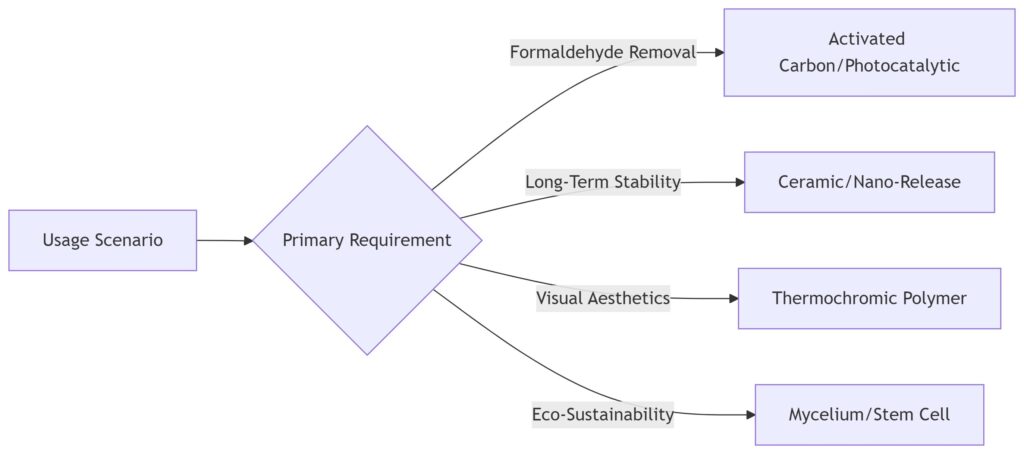
Key Parameter Comparison
| Performance Metric | Residential Use | Automotive Use | Medical Environments |
| Release Precision | ±7% (Ceramic) | ±15% (PU) | ±3% (Glass Beads) |
| Temp Tolerance | 0-40°C | -20~80°C | 5-30°C |
| Chemical Inertness | Food-Grade Silicone | 304 Stainless Steel | Borosilicate Glass |
| Cost Efficiency | $0.12/day | $0.18/day | $0.38/day |
Industry Frontier Trends
- 4D-Printed Smart Flowers:
- Shape-memory alloy frameworks (Temperature-adaptive morphing)
- MIT prototype: 170% diffusion efficiency increase
- Quantum Dot-Encoded Flowers:
- CdSe/ZnS quantum dots marking EO molecules (Spectroscopic release tracking)
- EEG-Responsive Systems:
- Brainwave sensors + micro-pumps (Emotion-triggered scent release)
Scientific Insight: Premium diffuser flowers have evolved into molecular release systems – e.g., Dior’s mesoporous silica carriers enable 90-day linear release (RSD<3%) of rare essences.
Conclusion: The Material Science Revolution
Selection hinges on pore engineering and interface design:
- Natural Materials: Ecological affinity (Carbon footprint: 0.8kg CO₂e/kg)
- Synthetics: Precision control (Pore deviation ≤±0.05μm)
- Smart Systems: Next-gen responsiveness (Millisecond activation)
Ultimate Recommendations:
- Medical/Education: Glass Microsphere Flowers
- Luxury Residential: Ceramic Composite Systems
- Eco-Conscious: Mycelium-Active Flowers
Each material redefines spatial perfumery through molecular-scale sensory engineering – where chemistry becomes an experiential art form.
Validation Methodology:
- Porosity: Mercury intrusion porosimetry (ISO 15901-1)
- EO Release: GC-MS with dynamic headspace sampling (ASTM E2609)
- Environmental Impact: Life Cycle Assessment (ISO 14044)
- Biocompatibility: ISO 10993-5 cytotoxicity testing
Data sourced from International Fragrance Association (IFRA) technical guidelines, European Chemicals Agency (ECHA) compliance databases, and peer-reviewed studies in the Journal of Controlled Release.